Electricity Fundamentals - Current, Voltage, and Resistance
Understanding the fundamental concepts of electrical current, voltage, and resistance that power robotic systems
Electricity Fundamentals
Electricity is the lifeblood of modern robotics. Every motor, sensor, and microcontroller relies on the flow of electrical energy. To design reliable robotic systems, you must understand three fundamental electrical concepts: current, voltage, and resistance.
Voltage (V)
What is Voltage?
Definition: Voltage is the electrical potential difference between two points. It's the "push" that drives electrons through a circuit.
Voltage (V) = Energy per unit charge
Unit: Volts (V)
Physical Analogy: Think of voltage like water pressure in a pipe - higher pressure pushes water harder through the pipe.
Voltage in Robotics
| Voltage Level | Common Name | Applications | Notes |
|---|---|---|---|
| 1.5-3V | Logic/Sensor voltage | Microcontroller I/O, sensors | Standard for many ICs |
| 5V | Standard logic | Arduino, most sensors | Very common in robotics |
| 12V | Common supply | Motors, LED arrays, solenoids | Good compromise |
| 24V | Industrial | Heavy-duty motors, large robots | More power delivery |
| 48V+ | High power | Large robots, autonomous vehicles | Battery packs, electric vehicles |
Voltage Sources
Example: Battery Series Connection
Connect batteries in series to increase voltage:
2 × 3.7V Li-ion cells in series = 7.4V
3 × 3.7V Li-ion cells in series = 11.1V
4 × 3.7V Li-ion cells in series = 14.8V
Figure: XT60 connectors commonly used for battery connections in robotics
Current (I)
What is Current?
Definition: Current is the flow of electrical charge through a conductor. It measures how many electrons pass through a point per second.
Current (I) = Charge per unit time
Unit: Amperes (A)
1 Ampere = 1 Coulomb per second
Physical Analogy: Current is like the amount of water flowing through a pipe - measured in gallons per minute.
Current Direction Conventions
Two conventions exist:
| Convention | Direction | Used In |
|---|---|---|
| Conventional | Positive to Negative | Circuit theory, most engineering |
| Electron Flow | Negative to Positive | Physics (actual electron movement) |
For robotics, we use conventional current (positive to negative).
Current in Robotics
Typical current draws:
| Component | Current Draw | Voltage | Power |
|---|---|---|---|
| LED | 20 mA | 5V | 0.1 W |
| Microcontroller | 50-100 mA | 5V | 0.25-0.5 W |
| Small servo | 200-500 mA | 5-6V | 1-3 W |
| DC motor (small) | 500-2000 mA | 6-12V | 3-24 W |
| Large motor | 5-20 A | 12-24V | 60-480 W |
| Entire mobile robot | 2-10 A | 12V | 24-120 W |
Ammeter Measurement
To measure current, use an ammeter connected in series with the circuit:
[+] Battery --> [Ammeter] --> [Load] --> [-] BatteryNever measure current in parallel
Connecting an ammeter in parallel creates a short circuit and damages the meter!
Resistance (R)
What is Resistance?
Definition: Resistance is the opposition to current flow in a circuit. It's caused by collisions between electrons and atoms in the conductor.
Resistance (R) = Opposition to current flow
Unit: Ohms (Ω)
Physical Analogy: Resistance is like friction in a pipe - it opposes water flow.
Resistivity and Resistance
For a conductor:
R = ρ × (L / A)Where:
- ρ (rho) = resistivity of material (Ω·m)
- L = length of conductor (m)
- A = cross-sectional area (m²)
Key insight: Longer wires have more resistance; thicker wires have less resistance.
Wire Gauge and Resistance
Thicker wires (lower AWG number) have lower resistance:
| AWG | Diameter (mm) | Resistance/100m | Use Case |
|---|---|---|---|
| 28 | 0.32 | 215 mΩ | Small signals, IC pins |
| 24 | 0.51 | 85 mΩ | Sensor connections |
| 20 | 0.81 | 33 mΩ | Motors, low-current power |
| 18 | 1.02 | 21 mΩ | Battery connections |
| 16 | 1.29 | 13 mΩ | High-current power |
| 14 | 1.63 | 8 mΩ | Very high current (>10A) |
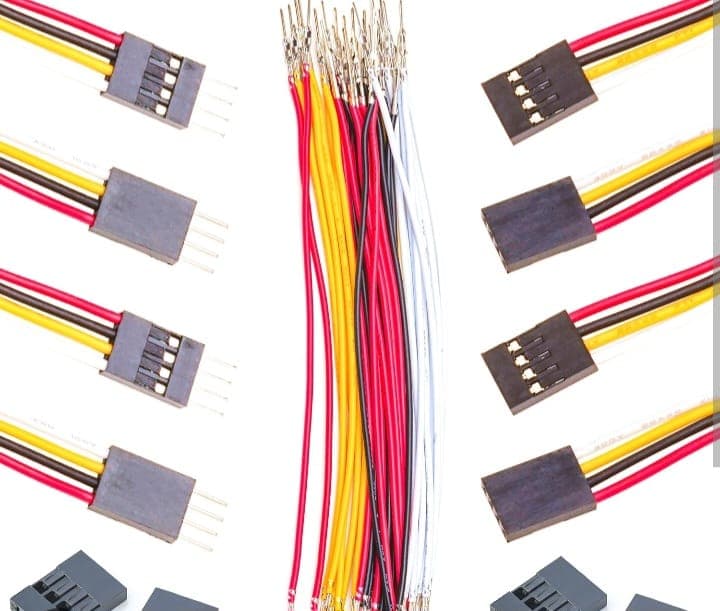
Figure: Wire gauge comparison - thicker wires for power, thinner for signals
Resistor Types in Robotics
The Water Pipe Analogy
Understanding voltage, current, and resistance is easier with an analogy:
Energy and Power from V, I, R
Relationships
Power (P) = Voltage × Current
P = V × I

Power in resistor:
P = I² × R
P = V² / R
Example: 12V battery with 5A motor
P = 12V × 5A = 60 WEnergy Consumption
Energy = Power × Time
E = P × t
E = V × I × t (Wh - Watt-hours)
Example: 60W motor running for 2 hours
E = 60 W × 2 hours = 120 WhSummary
Key Relationships:
- ✓ Voltage = Electrical potential difference (pushes electrons)
- ✓ Current = Flow of electrical charge (electrons moving)
- ✓ Resistance = Opposition to current flow (friction-like effect)
- ✓ Power = V × I (wattage consumed)
- ✓ Energy = Power × Time (total consumption)
Practical Tips:
- Understand typical voltage levels (5V, 12V most common)
- Calculate current draw before designing power system
- Choose proper wire gauge for current capacity
- Use proper resistors for protection and control
- Account for voltage drop in long wires
How is this guide?
Sensor Basics and Interfacing
Sensor types, signal conditioning, analog-to-digital conversion, and practical interfacing with microcontrollers for robotics
Energy Efficiency in Robotic Systems
Understanding and optimizing energy efficiency, power dissipation, heat management, and battery life in robotics