Mechanical and Structural Design
Transmission and Motion
Wheels, gears, chains, belts, pulleys, mechanical advantage, efficiency calculations, and motion transmission systems
Transmission and Motion
Transmissions convert motor output into useful motion. Proper selection affects speed, torque, efficiency, and power consumption.
Wheels and Tires
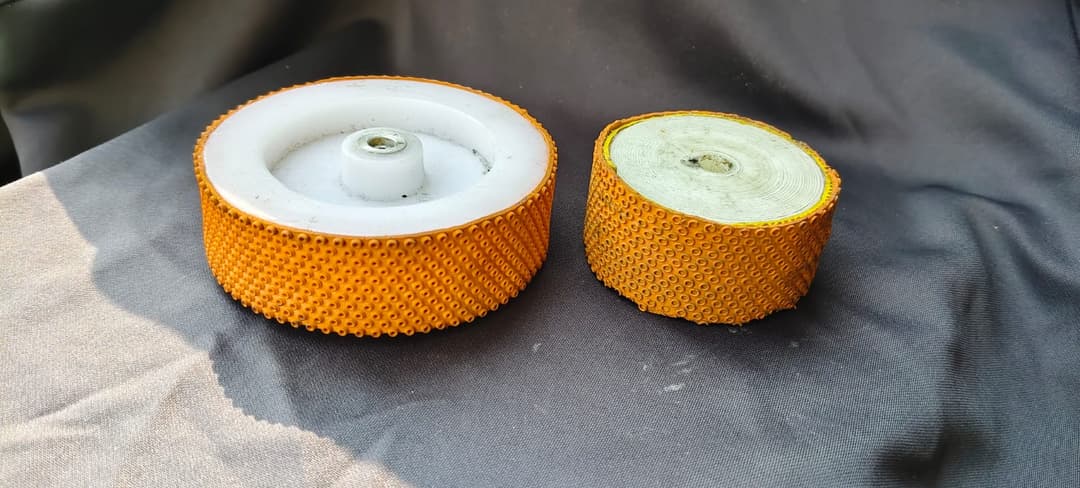
Figure: Various wheel types for different robot applications
Wheel Types
Omni-Directional (Omni Wheel)
Structure:
    Main wheel
       ↓
    ○───○  (small rollers around center)
   ○ ◯ ○   (blue = roller axis)
    ○───○

Motion:
├─ Forward: Main wheel pushes
├─ Side: Rollers allow sideways glide
├─ Rotate: In place rotation possible
└─ Diagonal: Any direction!

Advantages:
✓ Holonomic motion (any direction)
✓ No turning radius needed
✓ Perfect 90° turns

Disadvantages:
✗ Expensive ($30-60 each)
✗ Complex mechanically
✗ Less traction (roller slip)
✗ Requires 4 wheels minimum

Best for: Soccer robots, navigation in tight spaces
Mecanum Wheel
Structure:
  Angled rollers (45°)
     ↙ ↓ ↘
    □─◯─□  (rollers at 45°)
     ↙ ↓ ↘

Motion Pattern (4-wheel):
Forward:   All wheels rotate same direction
Strafe:    Left/right wheels opposite
Rotate:    Front/back opposite pairs
Diagonal:  Combinations of above

Result: Holonomic motion like omni wheels

Advantages:
✓ Holonomic capability
✓ Better traction than omni
✓ Simpler mechanism

Disadvantages:
✗ Expensive
✗ Requires precise alignment
✗ Complex control software
Standard Wheel (Most Common)
Simple cylinder (rubber or plastic)
     ↓
  [O] = Wheel on axle

Motion:
├─ Forward/backward: Rotates
├─ Steering: Must pivot entire wheel
└─ Sideways: Zero slip (must turn)

Advantages:
✓ Very cheap ($5-15 each)
✓ Simple mechanics
✓ Reliable and robust
✓ Good traction

Disadvantages:
✗ Requires turning radius
✗ Three-point turns needed
✗ Differential steering complex

Best for: Most robots (wheeled platforms)
Tire Material
Rubber:
Advantages: Best grip, durable, all-weather
Disadvantages: Heavy, wear over time, affected by temperature
Best for: Outdoor robots, off-road, high traction required
Polyurethane:
Advantages: Good grip, durable, consistent
Disadvantages: More expensive, overkill for most robots
Best for: Commercial-grade robots
Hard Plastic:
Advantages: Cheap, light, never wears
Disadvantages: Poor grip, slips on smooth surfaces
Best for: Smooth floor line-followers, indoors only
Wheel Size Selection
Small wheels (2-3 inches):
├─ Pro: Faster acceleration, responsive
├─ Con: Slower max speed, bouncy
└─ Best for: Line-followers, tight spaces

Medium wheels (4-6 inches):
├─ Pro: Good balance, stable
├─ Con: Average performance
└─ Best for: General mobile robots

Large wheels (8+ inches):
├─ Pro: Highest speed, smooth over obstacles
├─ Con: Slow acceleration, heavy
└─ Best for: Racing, outdoor terrain
Gears
Gear Types
Spur Gear (Parallel Shafts)
Structure:
    Teeth
      ▲
  ◯─●─◯  (flat teeth)
  ◯─●─◯
    ◯▼◯

Motion:
Input shaft ──→ [Teeth mesh] ──→ Output shaft
          90° rotation (shafts parallel)

Ratio calculation:
Output_speed = Input_speed × (Pinion_teeth / Gear_teeth)
Torque multiplies inversely

Example:
Input: 1000 RPM, 10 teeth
Output gear: 50 teeth
Output: 1000 × (10/50) = 200 RPM, 5× torque

Advantages:
✓ Simple, reliable
✓ Efficient (95%+)
✓ Compact
✓ Wide ratio range

Disadvantages:
✗ Noise at high speed
✗ Shaft misalignment causes wear
✗ Backlash (play) possible

Best for: Motors to wheels, gearbox stages
Bevel Gear (90° Shafts)
Structure:
    Shaft B
      ↑
  ◣───┤───◢
  ◢───┤───◣  ← Angled teeth (cone shape)
      ↑
    Shaft A

Motion: Right angle power transfer

Advantages:
✓ Compact 90° connection
✓ Good efficiency

Disadvantages:
✗ Expensive
✗ Complex to align
✗ Harder to replace
✗ Lower efficiency (80-90%)

Best for: Robot arms (elbow joints), differentials
Planetary Gear (Compact)
Structure (Epicyclic):
      Sun
       ◯
   ◯ ◢◣ ◯  ← Planets revolve
   ◢ ◯ ◣
      Ring

Motion:
Input: Sun or Ring
Output: Carrier (planets)
High ratio possible in compact space

Ratios: 3:1 to 100:1 in same space as spur

Advantages:
✓ Extremely compact
✓ Very high ratios possible
✓ Smooth operation
✓ Good efficiency

Disadvantages:
✗ Very expensive
✗ Complex mechanics
✗ Difficult to repair
✗ Backlash harder to control

Best for: Compact robot joints, servo gearboxes
Worm Gear (90° + High Ratio)
Structure:
    Worm shaft
        ↓ (screw-like)
      ▔▔▔▔▔
    ◯ ████ ◯
    ◯ ████ ◯
      ▁▁▁▁▁
        ↑
    Worm wheel

Motion:
Worm rotates 1 complete turn
Worm wheel rotates 1 tooth (high ratio!)

Ratio: 5:1 to 100:1 easily

Advantages:
✓ Extremely high ratio
✓ Compact
✓ Self-locking (no backdrive)
✓ Smooth quiet operation

Disadvantages:
✗ Very expensive
✗ Low efficiency (50-70%)
✗ Heat generation
✗ Limited to low-speed output

Best for: Robot arm joints, precision positioning
Gear Ratios
Formula:
Ratio = Pinion_teeth / Gear_teeth

Speed change:
Output_RPM = Input_RPM / Ratio

Torque change:
Output_torque = Input_torque × Ratio × Efficiency

Example Mobile Robot:
├─ Motor: 1000 RPM, 0.5 N⋅m
├─ Gearbox: 10:1 ratio, 95% efficiency
├─ Output: 100 RPM, 4.75 N⋅m
└─ Fast enough? Low torque? Adjust ratio!
Chains and Belts
Chain Drive
Structure:
    Sprocket
    (tooth wheel)
         ▲
    ◯───────◯  ← Chain links
    ◯───────◯
         ▼
    Sprocket

Motion:
Input sprocket → Chain → Output sprocket
Mechanical connection (no slip!)

Advantages:
✓ No slip (positive drive)
✓ Efficient (95%+)
✓ Can span long distances
✓ Tolerates misalignment
✓ Easy ratio changes (swap sprockets)

Disadvantages:
✗ Requires lubrication
✗ Noisy
✗ Heavy
✗ Needs tension adjustment
✗ Wears over time

Best for: Robot wheels, conveyor systems, outdoor robots
Belt Drive
Structure:
    Pulley
      ◯
    ┏━━━┓  ← Rubber belt
    ┗━━━┛
      ◯
    Pulley

Motion:
Input pulley → Belt grip → Output pulley
Friction drive (slight slip possible)

Types:
├─ Flat belt (simple, weak)
├─ V-belt (wedge grip, powerful, still smooth)
└─ Timing belt (teeth, positive drive)

Advantages:
✓ Smooth quiet operation
✓ Isolates vibration
✓ No maintenance (no lubrication)
✓ Doesn't need precision alignment

Disadvantages:
✗ Slip possible (especially flat belts)
✗ Speed sensitive (changes with wear)
✗ Tension must be correct
✗ Heat generation possible

Best for: Smooth power transmission, conveyor, fans
Ratio Calculation
Chain/Belt ratio depends on sprocket/pulley size:

Ratio = Driven_size / Driver_size

Example:
Input pulley: 30mm diameter
Output pulley: 90mm diameter
Ratio = 90/30 = 3:1 (3x slower, 3x more torque)

For chains (teeth count):
Input sprocket: 20 teeth
Output sprocket: 60 teeth
Ratio = 60/20 = 3:1
Mechanical Advantage
Definition
Mechanical advantage (MA) = Output force / Input force
Simple machine examples:

Lever:
    ↓ Force in
    │
────┼────────
    │        ↓ Load out

MA = Lever_arm_in / Lever_arm_out

Pulley:
    ☐ ← Fixed
    │
    │ ── Rope
    │
   Load

MA = Number_of_rope_segments

Incline:
   ╱╲
  ╱  ╲← Length
 ╱────╲
 Height

MA = Length / Height
Gearbox MA
Example 10:1 gearbox:

Input: 1 newton force (small gear)
Output: 10 newton force (large gear)
Mechanical Advantage = 10

Reality: Losses due to friction
├─ Efficient gearbox: 95% = 9.5× MA
├─ Chain drive: 95% = 9.5× MA
├─ Belt drive: 90-95% = 9-9.5× MA
└─ Worm gear: 60-70% = 6-7× MA
Compound Systems
Example: Gearbox (10:1) + Belt (3:1) + Chain (2:1)

Total ratio: 10 × 3 × 2 = 60:1

Efficiency:
├─ Gearbox: 95%
├─ Belt: 92%
├─ Chain: 95%
└─ Total: 0.95 × 0.92 × 0.95 = 83% efficiency

So: 60:1 mechanical advantage × 83% efficiency
     = 50× useful output
Motor Selection for Movement
Torque Calculation
Robot must overcome:
- Wheel friction
- Weight (on slopes)
- Acceleration resistance
Equation:
Torque_required = (Friction_coefficient × Weight × gravity × Radius)
                + (Weight × gravity × sin(angle) × Radius)
                + (Mass × Radius × Acceleration)

Example (flat ground):
├─ Weight: 10 kg
├─ Wheel radius: 0.05 m (5 cm)
├─ Friction coefficient: 0.1
├─ Torque = 0.1 × 10 × 9.81 × 0.05 = 0.49 N⋅m

Two motors (front wheel drive):
├─ Each motor needs: 0.49 N⋅m / 2 = 0.245 N⋅m
└─ Standard motor: 0.3 N⋅m works fine
Speed Calculation
Wheel speed = (Motor_RPM / Gear_ratio) × Wheel_circumference

Example:
├─ Motor: 300 RPM (after gearing)
├─ Wheel diameter: 0.1 m (10 cm)
├─ Circumference: π × 0.1 = 0.314 m
└─ Speed: 300 × 0.314 / 60 = 1.57 m/s = 5.7 km/h

Is this fast enough for competition? Depends on requirements!
Power Transmission Efficiency
Overall System Efficiency
Motor power → Losses → Final mechanical power

Typical breakdown (10W motor):
├─ Motor: 90% (inherent losses)
├─ Gearbox: 95% (friction in gears)
├─ Chain: 95% (friction, drive loss)
└─ Wheels: 97% (rolling resistance)

Total: 0.90 × 0.95 × 0.95 × 0.97 = 78% efficient

So: 10W motor × 78% = 7.8W useful mechanical power
Energy Loss Analysis
Where power goes (10W motor example):

Motor: 1W lost as heat
Gearbox: 0.5W lost (metal-to-metal friction)
Chain: 0.25W lost (link friction)
Wheels: 0.3W lost (rolling resistance)
Total losses: 2.05W
Useful: 7.95W

Solutions to improve:
├─ Better quality gears (reduce friction)
├─ Lubricate chain regularly
├─ Lower rolling resistance tires
├─ Reduce weight
└─ Use high-efficiency motor
Common Power Transmission Types
| Type | Ratio Range | Efficiency | Noise | Maintenance | Cost |
|---|---|---|---|---|---|
| Spur Gear | 2:1 - 50:1 | 95% | High | Low | Low |
| Planetary | 3:1 - 100:1 | 92% | Very Low | Very Low | High |
| Worm Gear | 5:1 - 100:1 | 60% | Very Low | Low | High |
| Chain Drive | 2:1 - 30:1 | 95% | High | Medium | Low |
| Belt Drive | 2:1 - 30:1 | 92% | Very Low | Low | Medium |
| Direct (no reduction) | 1:1 | 98% | Medium | None | Very Low |
Real-World Transmission Systems
Mobile Robot (Wheel Drive)
System:
Motor → Gearbox (10:1) → Wheel

Specs:
├─ Motor: 300 RPM, 0.5 N⋅m
├─ Gearbox: 10:1, 95% efficiency
├─ Output: 30 RPM, 4.75 N⋅m
├─ Wheel (5cm): Tangential force = Torque/Radius
│  = 4.75 N⋅m / 0.05 m = 95 N (enough to move!)
└─ Speed: 30 RPM × 2π × 0.05 / 60 = 0.157 m/s

For 1 m/s speed needed?
Required RPM: 1 m/s × 60 / (2π × 0.05) = 191 RPM
Gearbox ratio: 300 / 191 = 1.57:1 (lower reduction)
Robot Arm Joint
System:
Motor → Planetary gear (20:1) → Link arm

Specs:
├─ Motor: 200 RPM, 0.2 N⋅m
├─ Gearbox: 20:1, 92% efficiency
├─ Joint output: 10 RPM, 3.68 N⋅m
├─ Arm length: 0.3 m
├─ Load: Can hold 1.2 kg at end
│  (3.68 / 0.3 / 9.81 = 1.25 kg) ✓
└─ Speed: 10 RPM allows precise positioning

Tradeoff: Slow but strong (good for arms!)
High-Speed Conveyor
System:
Motor → Minimal reduction → Pulley

Specs:
├─ Motor: 1500 RPM, 0.1 N⋅m
├─ Reduction: 2:1 (just for extra torque)
├─ Output: 750 RPM, 0.19 N⋅m
├─ Pulley radius: 0.05 m
├─ Belt speed: 750 RPM × 2π × 0.05 / 60 = 3.93 m/s
├─ Carrying capacity: Good for light items
└─ Efficiency: 98% (direct drive, very efficient)

Tradeoff: Fast but weak (good for conveyor!)
Troubleshooting
Common Transmission Problems
Slipping belt/chain:
- Cause: Insufficient tension, worn belt, misalignment
- Solution: Tighten, replace, realign pulleys/sprockets
High noise/vibration:
- Cause: Misalignment, damaged gear teeth, loose mountings
- Solution: Check alignment, inspect for cracks, tighten fasteners
Excessive heat:
- Cause: High friction, poor lubrication, overload
- Solution: Use lubricant, reduce load, check efficiency
Motor stalls:
- Cause: Insufficient torque, binding, overload
- Solution: Reduce load, check for obstructions, increase gearing ratio
Loss of motion control:
- Cause: Backlash (play) in drivetrain
- Solution: Pre-tension system, use anti-backlash gears, adjust geometry
Design Checklist
Before selecting transmission:
- What torque is required? (Calculate from load)
- What speed is needed? (How fast must robot move?)
- What's available space? (Compact or large?)
- What's the budget? (Simple vs complex)
- How much noise acceptable? (Quiet or OK?)
- How often will maintenance occur? (Lubrication schedule?)
- What's the duty cycle? (Continuous or intermittent?)
- Must it be reversible? (Forwards and backwards?)
After selection:
- Motor and gearbox match in torque/speed output
- Driven components can handle calculated force
- Alignment is within tolerances
- Fasteners are properly secured
- Lubrication is applied per manufacturer spec
- System tested under full load
- Emergency stop works if applicable
Summary
Wheels:
- Standard wheels: simplest, most common
- Omni/Mecanum: holonomic motion, expensive
- Size and material affect grip and speed
Gears:
- Spur: efficient, simple, noisy
- Planetary: compact, high ratio
- Worm: self-locking, but inefficient
Transmission types:
- Direct drive: efficient, high speed, low torque
- Gearbox: adjustable speed/torque ratio
- Chain/belt: can span distances, smooth operation
Key calculations:
- Torque required = Load considerations
- Speed achievable = Motor RPM ÷ gear ratio
- Efficiency = Product of all component efficiencies
- Mechanical advantage = Force multiplication
How is this guide?