Electronic Speed Controllers (ESCs)
ESC types, specifications, calibration, programming, and practical interfacing with brushless motors in robotics
Electronic Speed Controllers (ESCs)
An ESC is the "brain" controlling a brushless motor. It takes a simple PWM signal and outputs sophisticated three-phase power to spin the motor at any desired speed.
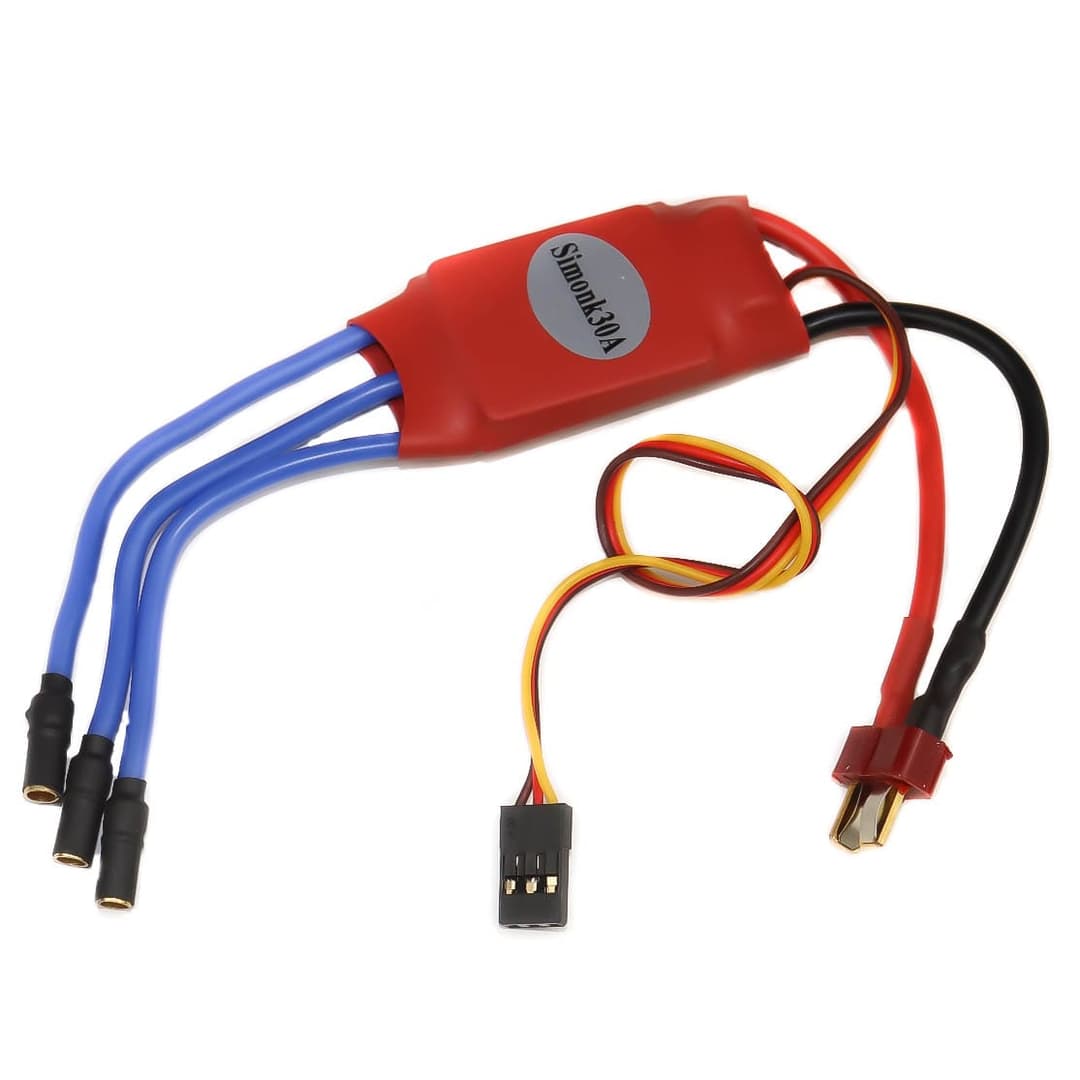
Figure: Electronic Speed Controller (ESC) - Controls brushless motor speed and direction
What ESCs Do
ESC Functions
Why Not Direct Battery?
Direct battery connection: Motor spins full RPM (no control)
ESC connection: Fine-grained control over entire RPM range
Plus: Built-in protection, current limiting, safety features
ESC Specifications
Key Ratings
Current rating:
ESC 30A specification means:
- Can handle 30A continuous current
- Peak: Usually 50-100A for short bursts
Voltage range:
ESC rated "2-6S" means:
- 2S LiPo: 7.4V minimum
- 6S LiPo: 22.2V maximum
Firmware types:
- BLHELI (most common)
- SimonK (good for racing)
- DShot (latest, digital communication)
Example Specifications: 40A ESC
Continuous current:     40A
Burst current:          60A
Voltage range:          2-6S LiPo (7.4-22.2V)
BEC output:             5V / 2A (for receiver)
Firmware:               BLHELI
Switchable frequency:   8 kHz or 16 kHz
Weight:                 28g
Motor Compatibility
Matching ESC to Motor
Motor KV rating (RPM per volt):
Motor KV 920 at 12V = 920 × 12 = 11,040 RPM max

ESC must handle this RPM:
Most ESCs: 200,000 ERPMs (electronic RPM)
Some racing ESCs: 400,000+ ERPMs

Check: Motor RPM < ESC max RPM (with margin)
Power Calculation
Power (W) = Voltage (V) × Current (A)

Example: 12V 30A ESC
Maximum power = 12V × 30A = 360W
ESC Connections
Standard Wiring
From battery:
  Red wire    → Battery positive
  Black wire  → Battery negative/GND

To motor:
  Three wires → Three motor coils (order can be reversed for direction)

From controller:
  Signal (white/yellow)   → PWM input
  Power (red)            → 5V from BEC
  Ground (black)         → Common ground
Three-Phase Motor Wires
ESC outputs: A, B, C phases
Motor coils: Phase A, B, C (color coded)

Connection: ESC A → Motor coil A, B → B, C → C
Reverse: Swap any two wires (e.g., A ↔ B) to reverse direction
BEC (Battery Elimination Circuit)
ESC supplies 5V regulated power to receiver/controller:
Battery → ESC
          ├─ Powers motor (high current)
          └─ BEC outputs 5V (2A typical)
                └─ Powers flight controller

Advantage: Only one battery needed
Disadvantage: ESC failure = no control
ESC Calibration
Why Calibration?
ESCs need to know PWM input range:
- Minimum signal (motor off)
- Maximum signal (full throttle)
Calibration Steps
Standard Throttle Calibration
- Connect battery (but not to ESC yet)
- Set transmitter/controller to maximum throttle
- Connect battery to ESC (beep sequence indicates calibration mode)
- Set transmitter to minimum throttle (beep confirms)
- Motor is now calibrated
Alternatively:
- Send maximum PWM (2000 µs)
- Send minimum PWM (1000 µs)
- Send neutral PWM (1500 µs)
Done!
Program Settings
Many ESCs allow programming (via transmitter clicks or PC):
- Rotation direction: CW or CCW
- Brake strength: 0% to 100%
- Cut-off voltage: Low voltage protection
- Frequency: 8kHz or 16kHz switching
- BEC voltage: 5.2V or 6.0V
Use manufacturer software or transmitter commands.
Reverse Motor Direction
Three methods (in order of preference):
1. Swap any two wires:
Original: Motor A → ESC A, B → B, C → C (CCW)
Swap A↔B: Motor A → ESC B, B → A, C → C (CW)
2. Software setting: Most ESCs can reverse via programming
3. ESC menu (if available): Menu option: Direction → Reverse
ESC Protection Features
Built-in Protections
1. Over-current protection
   └─ If current exceeds rating, throttle reduces

2. Low voltage cutoff (LVC)
   └─ Stops motor before battery dies completely

3. Over-temperature
   └─ Reduces current if ESC gets too hot

4. Stall protection
   └─ If motor can't spin, reduces power to prevent damage
Example: 40A ESC with 30A sustained
Motor jams (locked): Wants to draw 100A
ESC 40A limit: Throttles back to 40A
Over-current protection: Reduces to 30A after 5 seconds
Result: Motor protected, system doesn't burn out
ESC Troubleshooting
| Problem | Cause | Solution |
|---|---|---|
| Motor won't spin | Not calibrated | Recalibrate ESC |
| No signal | Check PWM connection | |
| Low voltage | Check battery | |
| Motor spins slowly | Calibration off | Recalibrate with full range |
| PWM frequency wrong | Check controller frequency | |
| Motor stutters/jerks | Bad connection | Reflow solder on wires |
| Firmware issue | Update BLHELI | |
| Excessive heat | Continuous overload | Reduce load or use larger ESC |
| Poor connections | Check solder joints | |
| Beeping patterns | Various codes | Check manual (armed/disarmed) |
Advanced ESC Features
DShot Protocol
Newest ESC standard using digital communication (not PWM):
Advantages:
✓ Precise control (11-bit resolution vs 8-bit PWM)
✓ Low latency (~25 µs vs 1000+ µs)
✓ Can read ESC telemetry (temperature, current)
✓ CRC error checking

Requirements:
- DShot-compatible flight controller
- DShot-compatible ESC
- Special cabling

Example: BLHeli_32 with DShot600
Telemetry
Some advanced ESCs send back data:
Data available:
- Actual RPM
- Current draw (amps)
- Temperature
- Voltage

Usage:
- Monitor motor health
- Detect problems early
- Adjust control in real-time
Programmable Features
Many ESCs allow adjustment via programming:
| Feature | Default | Range | Effect |
|---|---|---|---|
| Brake | On | 0-100% | Motor braking force |
| LVC | 6.0V | 4.5-8.0V | Low voltage cutoff |
| Start Force | 100% | 50-150% | Startup power |
| PWM Frequency | 8kHz | 8/16 kHz | Switching frequency |
Practical Example: Quadcopter ESC Setup
Battery: 4S LiPo (14.8V nominal)
Motors: 4× 920KV (11,040 RPM max at 14.8V)
ESCs: 4× 40A rated

Wiring:
Battery → Power Distribution Board (PDB)
PDB → ESC 1, 2, 3, 4 (power)
ESC 1,2,3,4 → Motors 1,2,3,4 (three-phase wires)

Signal:
Flight controller → ESC 1,2,3,4 (PWM on pins 1,2,3,4)

Calibration:
1. Max throttle on transmitter
2. Connect battery
3. Min throttle on transmitter (calibration complete)
Common ESC Models
| Model | Current | Voltage | Type | Price | Use |
|---|---|---|---|---|---|
| Turnigy Plush | 40A | 2-6S | Analog | $ | Multirotor |
| BLHeli_32 | 30-50A | 2-6S | BLHELI | $$ | Racing |
| KISS ESC | 24A | 2-6S | Ultra-fast | $$$ | FPV Racing |
| DJI ESC | 40A | 2-6S | DShot | $$$ | Phantom |
| Littlebee | 20A | 1-3S | Tiny | $ | Micro drones |
Summary
ESC Essentials:
✓ ESC turns simple PWM into three-phase motor control ✓ Match ESC current rating to motor requirements ✓ Calibration ensures full throttle range works ✓ Built-in protections prevent damage ✓ Reverse motor by swapping two wires
Selection Guide:
- Calculate motor current at full power
- Choose ESC rated 20-30% higher
- Verify voltage range matches battery
- Check firmware (BLHELI, DShot, etc.)
- Calibrate before first use
For Different Applications:
- Multirotor: Standard BLHELI 40-80A ESCs
- Racing: DShot, ultra-fast ESCs
- Robotics arm: 10-20A smooth torque ESC
- Rover: 60+ A high-current ESC
How is this guide?